
A small pre-seed round from Copenhagen caught my attention this week.
Palette has raised €3 million, led by Ugly Duckling Ventures, to build what its founders describe as a model-neutral “context layer” for AI-enabled companies. The four-person founding team includes repeat entrepreneur Brian Kyed, who spent a decade building his previous company. (Tech Funding News)
The idea is deceptively simple: Why should a company’s knowledge and workflow become permanently tied to whichever AI model happens to be winning this quarter?
Palette wants teams to keep their underlying context in their own systems while being able to switch between models and agents such as Claude, Codex, Mistral and Gemini.
The startup says its first paying customers came through a small design-partner programme, and the new capital is primarily going toward converting more of that early usage into paying customers. (Tech Funding News)
That last bit may actually be the more interesting story. At pre-seed, Palette isn’t spending the money to build a giant organisation.
It has eight people and plans to reach around ten. The funding is being used to answer a very specific question:
Will companies pay for this?
That’s a refreshing reminder for founders in the current AI rush. We sometimes talk about startups as if the objective is to build the biggest possible technical advantage as quickly as possible. But an alternative path is emerging:
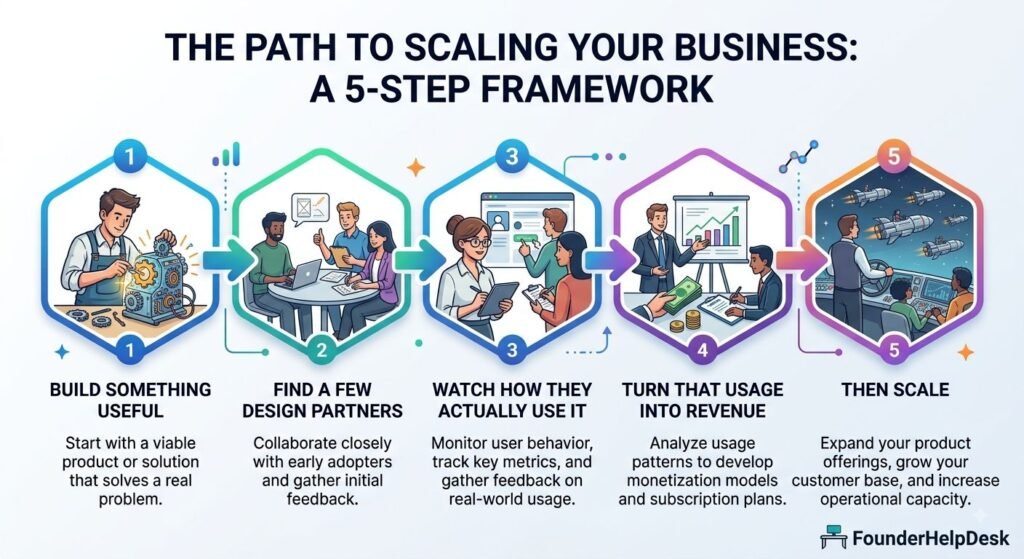
Build something useful → find a few design partners → watch how they actually use it → turn that usage into revenue → then scale.
For founders, three useful takeaways:
1. Don’t automatically build where the excitement is.
Sometimes the bigger opportunity is the problem created by the exciting technology.
2. Design partners can be more valuable than early vanity metrics.
A handful of companies using your product every day can teach you more than thousands of curious sign-ups.
3. Ask what becomes unavoidable if your thesis is right.
If every company eventually uses multiple AI models and agents, what infrastructure will they inevitably need?
That’s often a better startup question than:
“What AI product can we build?”
The takeaway:
You don’t always need to own the intelligence. Sometimes you can build the layer that makes intelligence usable, portable and dependable.
And that could be a very interesting place for founders to look over the next few years.
Question for founders:
If AI models continue getting cheaper and better at an astonishing pace, where do you think the durable startup moat moves next – data, workflow, context, distribution, or something we haven’t named yet?
Have a perspective, founder story, or topic we should explore? Reply to help@founderhelpdesk.in.